 Mit Google fortfahren

If-Clauses Typ 2: Regeln und Übungen
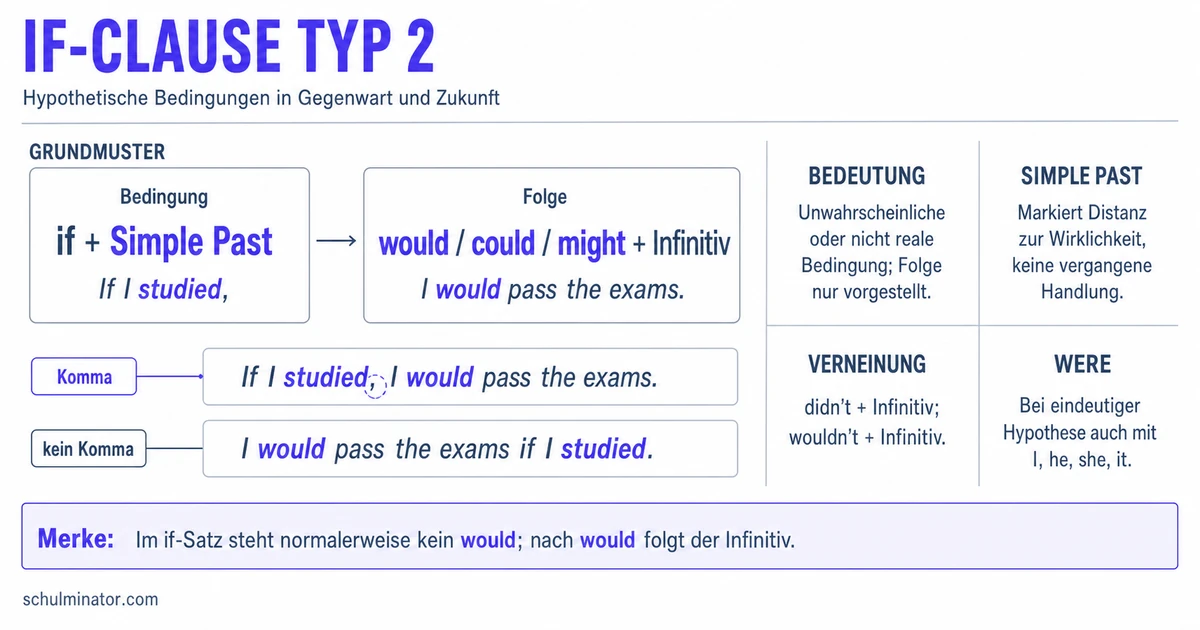
Mit einem If-Clause Typ 2 beschreibst du eine unwahrscheinliche, nur vorgestellte oder unmögliche Bedingung in der Gegenwart oder Zukunft. Das Grundmuster lautet: if + Simple Past, danach would + Infinitiv.
Auf dieser Seite lernst du, solche Bedingungssätze zu erkennen, richtig zu bilden und selbst zu formulieren.
Hake ab, was du schon kannst — und komm am Ende hierher zurück!
Wann brauchst du Typ 2?
Stell dir vor, du hast keinen Garten. Trotzdem kannst du überlegen, was du mit einem Garten tun würdest:
If we had a garden, we would grow our own vegetables.
Die Aussage bedeutet: Wir haben keinen Garten oder halten einen Garten zumindest für unwahrscheinlich. Deshalb ist auch das Gemüseanbauen nur eine vorgestellte Folge.
Hypothetische Bedingung
Eine hypothetische Bedingung ist nur vorgestellt, unwahrscheinlich oder nicht mit der gegenwärtigen Wirklichkeit vereinbar. Typ 2 bezieht sich dabei auf die Gegenwart oder Zukunft.
Das Simple Past in if we had bezeichnet hier keine vergangene Handlung. Es schafft Abstand zur Wirklichkeit: Wir stellen uns eine andere Situation vor.
If I were rich, I would buy a yacht.
- Wirklichkeit: Die Person ist nicht reich.
- Vorgestellte Bedingung: If I were rich ...
- Mögliche Folge: ... I would buy a yacht.
So bildest du Bedingung und Folge
Ein Typ-2-Satz besteht aus zwei Teilen:
| Teil | Form | Beispiel |
|---|---|---|
| Bedingung | if + Simple Past | if I studied |
| Folge | would + Infinitiv ohne to | I would pass |
Zusammen ergibt sich:
If I studied, I would pass the exams.
Die Bedingung steht im Simple Past: studied. Die vorgestellte Folge enthält would und die Grundform pass.
Im normalen Grundmuster steht kein would im if-Satz. Schreibe If I studied, nicht If I would study.
Ausgangssituation: Mia wohnt weit vom Strand entfernt und surft deshalb nicht jedes Wochenende.
- Bedingung vorstellen: If Mia lived closer to the beach ...
- Folge ergänzen: ... she would go surfing every weekend.
- Ganzer Satz: If Mia lived closer to the beach, she would go surfing every weekend.
Lived zeigt die hypothetische Bedingung. Would go bezeichnet die vorgestellte Folge.
So wechselst du Satzstellung und Komma
Bedingung und Folge dürfen ihre Plätze tauschen. Die Bedeutung bleibt gleich:
- If I studied, I would pass the exams.
- I would pass the exams if I studied.
Beginnt der Satz mit dem if-Satz, setzt du danach ein Komma. Steht der if-Satz am Ende, setzt du in diesem Muster kein Komma.
If-Satz zuerst: Komma nach der Bedingung. If-Satz am Ende: kein Komma zwischen Folge und Bedingung.
So verneinst und variierst du Typ 2
Du kannst die Bedingung, die Folge oder beide Teile verneinen.
Die Bedingung verneinen
Bei gewöhnlichen Verben verwendest du did not oder didn't und danach den Infinitiv:
If she didn't work so much, she would have more free time.
Bei to be steht not nach der Verbform:
If you weren't hungry, I wouldn't make you a sandwich.
Die Folge verneinen
Aus would wird would not oder wouldn't:
If I was rich, I wouldn't buy a big house.
Would, could oder might wählen
Im Hauptsatz kannst du unterschiedliche Bedeutungen ausdrücken:
- would + Infinitiv: vorgestellte Folge
- could + Infinitiv: hypothetische Fähigkeit oder Möglichkeit
- might + Infinitiv: unsichere Möglichkeit
- If I studied, I would pass the exams. – Ich würde sie bestehen.
- If I studied, I could pass the exams. – Ich könnte sie bestehen.
- If I studied, I might pass the exams. – Vielleicht würde ich sie bestehen.
Was oder were?
Für eine eindeutig hypothetische Aussage ist were besonders typisch:
If I were you, I would take the chance.
Die Form were kann in solchen Aussagen auch bei I, he, she und it stehen. If I was ... kann dagegen eine mögliche reale Vergangenheit bezeichnen, zum Beispiel in Sorry if I was rude earlier. In Typ-2-Beispielen kommt ebenfalls was vor; mit If I were you verwendest du die besonders gebräuchliche hypothetische Form.
So formulierst du eigene Typ-2-Sätze
Gehe in vier Schritten vor:
- Bestimme, welche Situation nicht real oder eher unwahrscheinlich ist.
- Forme diese Bedingung mit if + Simple Past.
- Formuliere die Folge mit would, could oder might + Infinitiv.
- Prüfe Satzstellung, Komma und Bedeutung.
Ausgangslage: Leo kann nicht Klavier spielen. Deshalb tritt er nicht der Schulband bei.
Bedingung: If Leo knew how to play the piano ... Folge: ... he would join the school band.
Vollständiger Satz: If Leo knew how to play the piano, he would join the school band.
Übung
Bilde aus jeder Situation einen Typ-2-Satz.
- We don't have a yacht. We don't sail around the world.
- I am not invisible. I can't go anywhere unnoticed.
- Sara stays up late. She feels tired.
Lösung und Denkweg
- If we had a yacht, we would sail around the world. – Had bezeichnet den vorgestellten Besitz; would sail ist die Folge.
- If I were invisible, I could go anywhere unnoticed. – Were markiert die hypothetische Situation; could go drückt die vorgestellte Möglichkeit aus.
- If Sara didn't stay up late, she wouldn't feel so tired. – Die Bedingung wird mit didn't + Infinitiv verneint; die verneinte Folge lautet wouldn't feel.
Karteikasten
Überlege zuerst selbst und drehe die Karte anschließend zum Prüfen um.
Alles auf einen Blick
- If-Clauses Typ 2
- Bedeutung: unwahrscheinlich oder hypothetisch
- Bedingung: if + Simple Past
- Folge: would, could oder might + Infinitiv
- Verneinung: didn't oder wouldn't
- Satzstellung: Bedingung zuerst oder am Ende
- Komma: nach vorangestelltem if-Satz
- Besonderheit: If I were you
Abschluss-Check
Du beherrschst Typ 2, wenn du zuerst die Bedeutung prüfst und dann die beiden Formen sauber trennst: if + Simple Past für die hypothetische Bedingung, would, could oder might + Infinitiv für die Folge.